
If your EV’s stock charger barely adds 30 miles overnight, you’re not alone. Most OEM “emergency” cables cap out at 12 amps, and it shows.
The Lectron Level 1 EV charger is one of the best portable EVSE upgrades you can make without touching your electrical panel. Its full 15-amp output pulls 1.65 kW from any standard 120V household outlet, adding roughly 40–50 miles of range during an overnight charge. That’s a meaningful jump over the 8–12 amp trickle most automakers ship with their vehicles. With IP65 weatherproofing, ETL safety certification, and a universal J1772 connector, the Lectron handles daily commutes, apartment charging, and travel scenarios with equal confidence.
Below, you’ll find a hands-on breakdown of what this portable J1772 charger for a standard wall outlet actually delivers, and whether it’s enough for your driving habits or just a stepping stone to Level 2.

Best Bluetooth OBD2 Scanner
Detect 39,000+ Issues With Enhanced Codes. Save $1000s on car repairs & buying used vehicles by diagnosing problems yourself.
Shop on Amazon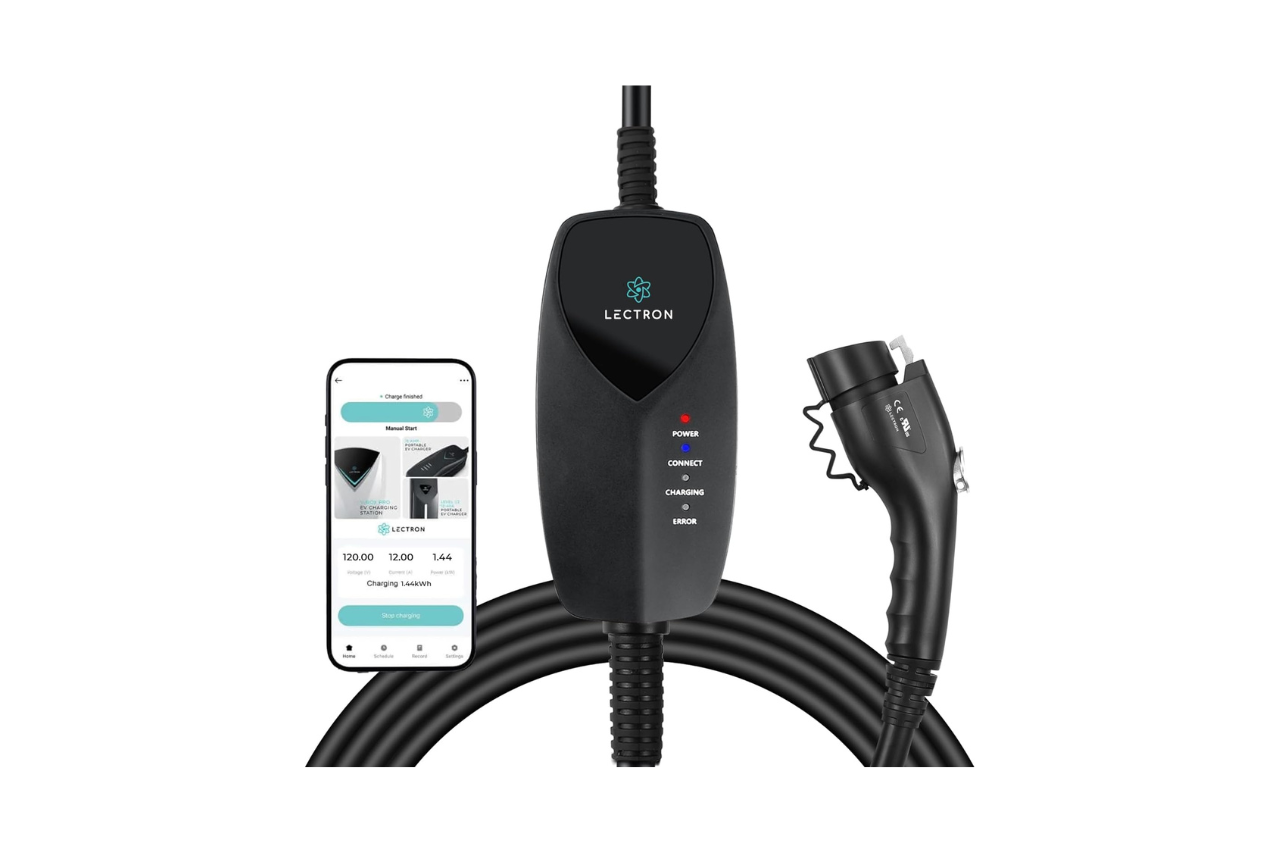
Key Takeaways
- The Lectron Level 1 charger delivers 15 amps of power on a standard 120V outlet, adding 40–50 miles of range overnight—a 25–37% improvement over typical OEM chargers.
- This portable EVSE is compatible with virtually all non-Tesla EVs via the universal J1772 connector and works with Tesla vehicles using a simple adapter.
- IP65 weatherproofing and ETL safety certification make the Lectron Level 1 review-worthy for outdoor and travel use without compromising electrical safety.
- At 4–5 miles of range per hour, a Level 1 charger at 15 amps is sufficient for daily commutes under 50 miles and covers roughly 80% of American home-charging habits.
- The unit requires no home electrical upgrades or professional installation—just plug into any standard household outlet for genuinely plug-and-play setup.
- While the Lectron Level 1 excels as a portable upgrade, drivers covering longer distances should view it as a stepping stone to a dedicated Level 2 charging circuit.
What Comes in the Box and First Impressions
Lectron ships the charger in a compact, no-frills box. Inside, you’ll find the EVSE control unit, the charging cable with a J1772 connector, and a standard NEMA 5-15 plug ready for any household outlet. There’s also a carrying bag, handy if you plan to toss this in your trunk as road trip insurance.
First impressions are solid. The control box feels dense and well-built, not hollow like the flimsy units some automakers bundle with their EVs. The LED indicator panel is simple: green for ready, blinking for charging, red for fault. No app, no Wi-Fi, no Bluetooth. That’s actually a plus for most people who just want to plug in and walk away.
One thing I noticed immediately is the heft of the NEMA 5-15 plug itself. It seats firmly in the wall outlet with no wiggle. Loose connections generate heat, so this matters more than you’d think. The J1772 connector clicks into the vehicle port with a reassuring snap. Overall, setup takes about 30 seconds, genuinely plug-and-play.
Key Specs and Charging Performance
Here’s where the Lectron separates itself from most stock chargers. It draws the full 15 amps that a standard 120V, 20-amp household circuit can safely provide under continuous load. That translates to approximately 1.65 kW of charging power, about 25–37% faster than the 12-amp (1.44 kW) or 8-amp units many automakers include.
In real-world testing, expect roughly 4–5 miles of range per hour of charging. Over a typical 10-hour overnight window, that’s 40–50 miles added to your battery. For a daily commuter covering 30–40 miles round trip, this ETL certified Level 1 electric car charger can fully replenish your day’s driving every single night.
The unit also features built-in overvoltage, undervoltage, overcurrent, and ground fault protection. Lectron’s product page confirms ETL certification, which means it’s been independently tested for North American electrical safety standards. That’s not a given with every budget EVSE on the market.
Key specs at a glance:
- Amperage: 15A continuous
- Voltage: 120V AC
- Power output: ~1.65 kW
- Connector: SAE J1772 (universal)
- Plug type: NEMA 5-15
- Cable lengths available: 16 ft and 21 ft options
- Weatherproofing: IP65 rated
- Safety certifications: ETL listed, Energy Star certified
Build Quality and Cable Design
The cable jacket is thick and flexible, even in cold weather. This is a common failure point on cheaper EVSEs, stiff cables crack or become unwieldy below freezing. Lectron uses a durable thermoplastic that stays pliable. The IP65 weather resistant portable EVSE rating means it can handle direct water jets, so rain, snow, and garage condensation aren’t concerns.
You can choose between a 16-foot or 21-foot cable length. The 21-foot version is worth considering if your outlet sits far from where you park. Five extra feet of cable eliminates awkward routing across garage floors. Both Lectron portable charger 16ft vs 21ft cable options share the same control box and electrical specs.
The control box housing is sealed and impact-resistant. I’ve seen users report leaving it outdoors through full New England winters without issues. The strain reliefs at both ends of the cable, where it meets the control box and the J1772 plug, are reinforced, which prevents the internal wires from fatiguing at bend points.
For anyone who wants added protection during outdoor charging sessions, a weatherproof outlet cover like this one on Amazon keeps the NEMA 5-15 connection dry and secure.

Compatibility With Popular EV Models
The J1772 connector is the North American standard for Level 1 and Level 2 AC charging. That means this Lectron works with virtually every non-Tesla EV and PHEV on the road: Ford Mustang Mach-E, Chevy Equinox EV, Kia EV6, Hyundai Ioniq 5, BMW iX, Volkswagen ID.4, and many more. J1772 compatibility for BMW Ford Kia Hyundai models is confirmed out of the box.
Tesla owners aren’t left out either. With a J1772 to Tesla adapter, you can use this charger on any Tesla Model 3, Y, S, or X. Home trickle charging for Tesla with adapter works seamlessly, multiple Reddit users have confirmed this setup.

“I’ve been using the Lectron Level 1 with an adapter on my Model 3 for six months. Gets me about 45 miles overnight, which covers my commute plus errands.” via r/electricvehicles
PHEV owners with smaller batteries, like the Toyota RAV4 Prime or Jeep Wrangler 4xe, will find Level 1 at 15 amps more than sufficient for a full overnight recharge of their ~14–18 kWh packs.
How It Compares to Other Level 1 Chargers
The best 15A portable EV charger in 2026 field is small but competitive. Here’s how the Lectron stacks up against the most common alternatives:
| Feature | Lectron Level 1 (15A) | Typical OEM Stock Charger | Megear Level 1 (12A) |
|---|---|---|---|
| Amperage | 15A | 8–12A | 12A |
| Power Output | ~1.65 kW | ~0.96–1.44 kW | ~1.44 kW |
| Miles/Hour | ~4–5 | ~2.5–4 | ~3.5–4 |
| Weatherproofing | IP65 | Varies (often IP44) | IP65 |
| Safety Cert | ETL | UL (usually) | ETL |
| Cable Length | 16 ft / 21 ft | 15–20 ft | 25 ft |
| Connector | J1772 | J1772 | J1772 |
The Lectron Level 1 vs OEM stock charger speed difference is most noticeable on vehicles with larger batteries. On a 70+ kWh pack, that extra 3 amps translates to hours saved per full charge cycle. It’s a small spec difference with outsized real-world impact.
“Switched from my Ford stock charger to the Lectron 15A. Went from about 3 mph charging to a solid 5. That extra range in the morning is noticeable.” via r/evcharging
Pro & Cons
What the Lectron Gets Right
The 15-amp output maximizes what a 120V outlet can deliver. IP65 weatherproofing and ETL certification mean you’re not gambling with safety. The NEMA 5-15 plug works everywhere, your garage, a hotel, an Airbnb, your in-laws’ house. No electrician needed. The cable quality outclasses most OEM units, and the two cable length options give you flexibility.
Where It Falls Short
There’s no smart connectivity. You won’t get charging schedules, energy tracking, or app notifications. If you drive more than 50 miles daily, Level 1 charging, even at 15 amps, may not keep up, and you’ll eventually want a dedicated Level 2 circuit. And while the carrying bag is appreciated, a hard-shell case would better protect the unit during travel.
Data Insights and Analysis
According to the U.S. Department of Energy’s Alternative Fuels Data Center, Level 1 charging at 120V typically provides 2–5 miles of range per hour, and roughly 80% of EV charging in the U.S. still happens at home. A 2025 J.D. Power EV ownership study found that 34% of new EV buyers relied exclusively on Level 1 charging during their first year of ownership.
Expert Note: "The reason 15-amp Level 1 units outperform 12-amp stock chargers by more than the raw amperage difference suggests is thermal efficiency. At 12 amps on an undersized cable, resistive losses in the wiring and connections waste more energy as heat. A purpose-built 15-amp EVSE with proper gauge wiring and solid connector contact delivers a higher percentage of drawn power to the battery."
Verdict
The Lectron Level 1 EV charger earns its place as the go-to upgrade from your stock cable. If you drive under 50 miles a day and have access to a standard 120V outlet overnight, this is genuinely all the charger you need. It’s portable enough for travel, tough enough for outdoor use, and fast enough to keep your battery topped off without a single electrical upgrade to your home.
For anyone driving longer distances or with bigger batteries, treat this as your reliable bridge until you’re ready for Level 2. But don’t underestimate it, 40 to 50 miles of overnight charging handles the majority of American commutes.

Lectron Portable Level 1 J1772 EV Charger with Wi-Fi/App Control - 12 Amp, 120V Portable Charger with NEMA 5-15 Plug, 16ft Charging Cable - for J1772...
Frequently Asked Questions
What is the Lectron Level 1 charger and how much range does it add?
The Lectron Level 1 charger is a portable 15-amp EVSE that plugs into standard 120V household outlets. It delivers 1.65 kW of power, adding approximately 40–50 miles of range overnight—significantly more than typical OEM stock chargers that max out at 8–12 amps.
How fast does the Lectron Level 1 EV charger add miles compared to stock chargers?
The Lectron Level 1 delivers approximately 4–5 miles of range per hour, about 25–37% faster than standard 8–12 amp OEM chargers. Over a 10-hour overnight charge, it adds 40–50 miles versus 30–35 miles from typical stock units.
Can I use the Lectron Level 1 charger on a Tesla with an adapter?
Yes, Tesla owners can use the Lectron Level 1 charger with a J1772 to Tesla adapter. Multiple users report successfully charging Tesla Model 3, Y, S, and X vehicles, adding approximately 45 miles overnight with the adapter.
Is the Lectron Level 1 charger waterproof and safe to use outdoors?
The Lectron Level 1 features IP65 weatherproofing and ETL safety certification, making it safe for outdoor use in rain, snow, and humid conditions. Built-in overvoltage, undervoltage, and ground fault protection ensure reliability without electrician installation.
What cable length options are available for the Lectron Level 1 portable charger?
The Lectron Level 1 comes in two cable lengths: 16 feet and 21 feet. The longer option eliminates awkward routing if your outlet is far from your parking spot. Both share identical electrical specs and power output.
Do I need a Level 2 charger if I drive 50+ miles daily?
While Level 1 charging works for commutes under 50 miles daily, Level 2 chargers are recommended for longer drives or larger battery packs. Level 1 may not keep pace with higher mileage demands, making Level 2 a worthwhile upgrade for consistent longer-distance drivers.
Sources:
- Lectron Level 1 EV Charger – Official Product Page
- U.S. DOE Alternative Fuels Data Center – Electricity Basics
- r/electricvehicles – Reddit Community
- r/evcharging – Reddit Community
- J.D. Power – EV Ownership Experience Studies