
That glowing orange dashboard light is more than an annoyance, it’s your IS250 telling you something needs attention. For Lexus IS250 owners, the check engine light often signals issues unique to the 2.5L 4GR-FSE direct-injection V6, from carbon-clogged intake valves to misfiring ignition coils.
The Lexus IS250 check engine light typically illuminates due to oxygen sensor failures, carbon buildup on intake valves causing misfire codes P0300-P0306, catalytic converter inefficiency (P0420), mass air flow sensor contamination, or EVAP system leaks often triggered by a loose gas cap. Direct-injection engines like the 4GR-FSE are particularly prone to valve carbon deposits that disrupt airflow and combustion, leading to rough idling, hesitation during acceleration, and persistent warning lights.
This guide walks you through the most common trouble codes, diagnostic steps using an OBD-II scanner, and whether you should attempt DIY fixes or head to a professional. You’ll learn how to identify what’s causing that light and restore your IS250’s crisp throttle response.
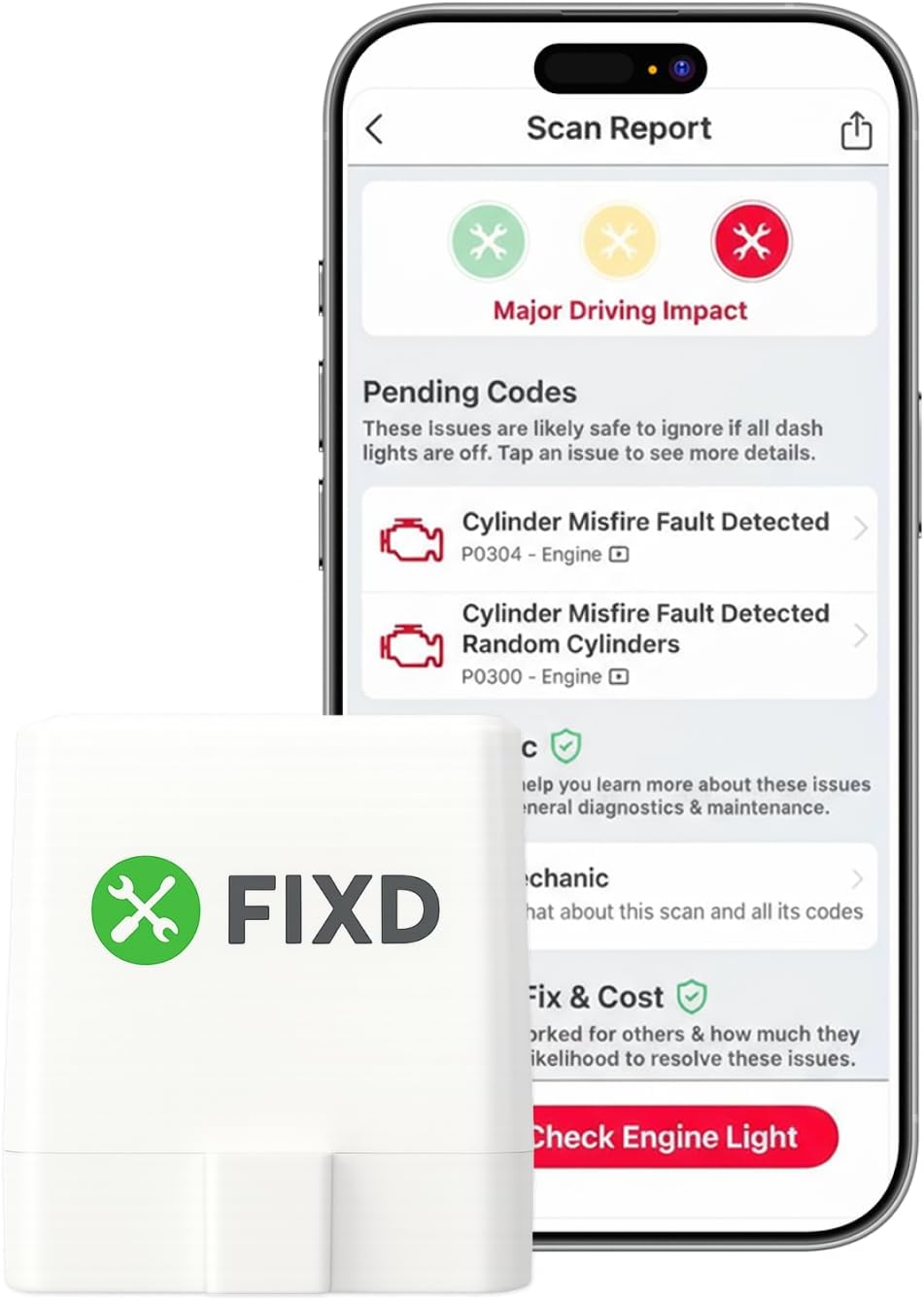
Best Bluetooth OBD2 Scanner
Detect 39,000+ Issues With Enhanced Codes. Save $1000s on car repairs & buying used vehicles by diagnosing problems yourself.
Shop on Amazon
Key Takeaways
- Use an OBD-II scanner to read trouble codes at the diagnostic port under the dashboard, then clear codes and test-drive through varied conditions to confirm whether the check engine light issue is active or intermittent.
- The Lexus IS250 check engine light most commonly stems from oxygen sensor failure, carbon buildup on intake valves (unique to direct-injection engines), faulty mass air flow sensors, or EVAP system leaks—all requiring different diagnostic and repair approaches.
- Simple DIY fixes include tightening the gas cap, cleaning the MAF sensor, and replacing spark plugs, while oxygen sensor replacement, ignition coil service, and intake valve carbon cleaning require professional tools or dealer expertise.
- Misfire codes (P0300-P0306) and lean codes (P0171/P0174) are especially common in IS250s over 60,000 miles due to carbon deposits that accumulate on direct-injection engine valves, disrupting airflow and combustion.
- A flashing check engine light indicates severe misfires that can damage the catalytic converter within minutes, while a steady light may allow continued driving but warrants prompt diagnosis to avoid secondary damage and failed emissions tests.
- Preventive maintenance—using Top Tier gasoline, replacing air filters every 30,000 miles, and following the 60,000-mile spark plug interval—reduces check engine light frequency and extends your IS250’s engine life.
Understanding the Check Engine Light in Your Lexus IS250
Your check engine light (CEL) is part of the onboard diagnostics system (OBD-II) that constantly monitors engine performance, emissions, and sensor data. When the ECU detects a parameter outside normal operating range, like irregular oxygen sensor voltage or cylinder misfires, it stores a diagnostic trouble code (DTC) and triggers the amber warning.
In the IS250, the check engine light may appear alone or alongside the VSC (Vehicle Stability Control) and traction control lights. When all three illuminate together, the ECU has disabled stability systems as a safety precaution because engine misfires or sensor faults can disrupt torque calculations.
Don’t ignore a steady CEL. While a flashing check engine light indicates severe misfires that can damage the catalytic converter, a steady glow still warrants prompt diagnosis. The 4GR-FSE direct-injection engine is particularly sensitive to fuel quality, intake valve cleanliness, and ignition system health, small issues escalate quickly in high-compression motors.
Most Common Causes of Check Engine Light in Lexus IS250
Oxygen Sensor Failure
Oxygen sensors (O2 sensors) measure exhaust gas oxygen content to help the ECU adjust air-fuel mixture. The IS250 uses upstream (pre-cat) and downstream (post-cat) sensors on both banks. Bank 1 Sensor 2 and Bank 2 Sensor 2 failures are common after 80,000–100,000 miles, triggering codes P0136, P0156, P0420, or P0430.
Symptoms include poor fuel economy, sluggish acceleration, and rough idle. Downstream sensor failures typically don’t cause drivability issues but will illuminate the CEL due to catalyst monitoring. Replacing a failed O2 sensor requires a quality OEM or Denso unit, cheap aftermarket sensors often throw false codes.
You’ll need a 22mm oxygen sensor socket and access from underneath the vehicle. Before replacing, inspect wiring harnesses for rodent damage or corrosion, especially near the exhaust manifold where heat cycles stress connectors. Clear the codes after replacement and drive through a complete warm-up cycle to verify the fix.
Faulty Mass Air Flow Sensor
The mass air flow (MAF) sensor sits between the air filter and throttle body, measuring incoming air volume so the ECU can calculate proper fuel delivery. Contamination from oil residue (often from over-oiled aftermarket air filters) or dust causes erratic readings, triggering codes P0171 (System Too Lean Bank 1) or P0174 (System Too Lean Bank 2).
You’ll notice hesitation during acceleration, rough cold starts, and occasional stalling at idle. The IS250 MAF sensor is a hot-wire type, extremely sensitive to debris. Cleaning the sensor with MAF-specific spray can restore function without replacement.

Remove the sensor (two screws), spray the delicate wire elements with short bursts, and let it air-dry completely before reinstallation. Never use throttle body cleaner or carburetor cleaner, these leave residue that worsens readings. If cleaning doesn’t resolve the codes, replacement runs around $150–$300 for a Denso or OEM unit.
Catalytic Converter Issues
P0420 (Catalyst System Efficiency Below Threshold Bank 1) is one of the most common IS250 codes, especially on vehicles approaching 150,000 miles. This code doesn’t always mean the catalytic converter itself has failed, it often indicates the downstream oxygen sensor detects exhaust gas composition too similar to upstream readings, suggesting the catalyst isn’t processing emissions efficiently.
Root causes include prolonged driving with misfires (unburned fuel damages catalyst substrate), oil consumption from worn piston rings coating the catalyst, or simply age-related degradation. Before replacing a $1,200+ catalytic converter, address any misfire codes first and verify O2 sensor operation.
Some owners report P0420 clearing after Italian tune-ups (hard highway acceleration to burn carbon deposits) or fuel system cleaning, but these are temporary. California and other CARB states require OEM-grade catalytic converters: aftermarket units won’t pass emissions testing in strict jurisdictions.
How to Diagnose Your IS250 Check Engine Light
Using an OBD-II Scanner to Read Trouble Codes
Your first diagnostic step is pulling stored trouble codes with an OBD-II scanner. The diagnostic port is located under the dashboard on the driver’s side, just above the hood release lever. Plug in your scanner, turn the ignition to ON (don’t start the engine), and let the device communicate with the ECU.
Basic code readers cost $20–$40 and display codes like P0300 or P0171, but they don’t show live data or freeze-frame parameters. Advanced Bluetooth OBD-II scanners pair with smartphone apps to show real-time sensor values, pending codes, and manufacturer-specific Lexus DTCs beyond generic OBD-II codes.

Write down all codes before clearing them, patterns matter. Multiple cylinder misfire codes (P0301, P0303, P0305 all on one bank) suggest ignition coil pack failure or carbon buildup on that bank’s intake valves. A single random misfire (P0300) often points to a loose gas cap causing EVAP system pressure fluctuations.
After noting codes, clear them and test-drive the vehicle through varied conditions: cold start, highway cruising, stop-and-go traffic. If the same code returns immediately, you’ve confirmed an active fault. If it takes days to return, you’re chasing an intermittent issue, check wiring connections and connectors for corrosion.
Common Trouble Codes for Lexus IS250
Here’s a breakdown of frequent IS250 diagnostic trouble codes:
| Code | Description | Common Cause |
|---|---|---|
| P0300 | Random/Multiple Cylinder Misfire | Carbon buildup on intake valves, weak ignition coils |
| P0301-P0306 | Cylinder-Specific Misfire | Fouled spark plug, failed ignition coil, valve carbon |
| P0171/P0174 | System Too Lean Bank 1/2 | Dirty MAF sensor, vacuum leak, weak fuel pump |
| P0420/P0430 | Catalyst Efficiency Below Threshold | Aged catalytic converter, failed O2 sensor |
| P0441 | EVAP Incorrect Purge Flow | Faulty purge valve, loose gas cap |
| P0456 | EVAP Small Leak Detected | Loose or damaged gas cap, cracked EVAP hose |
Misfire codes (P0300-P0306) are especially common in IS250s with over 60,000 miles due to direct-injection carbon buildup. Unlike port-injected engines, the 4GR-FSE sprays fuel directly into the combustion chamber, so intake valves never get washed by gasoline. Carbon accumulates on valve stems and seats, disrupting airflow and causing incomplete combustion.
Lean codes (P0171/P0174) often accompany rough idle and hesitation. Start with MAF sensor cleaning, it’s free and solves the problem 60% of the time. If codes persist, inspect intake boot connections for cracks and check PCV valve operation. A failing fuel pump can also cause lean conditions, though you’d typically notice hard starts and power loss under load.
Can You Drive With the Check Engine Light On?
Driving with a steady check engine light is possible short-term, but you’re risking secondary damage and failed emissions tests. If the light is flashing, pull over immediately, that indicates severe misfires dumping raw fuel into the exhaust, which can overheat and destroy the catalytic converter within minutes.
A steady CEL for issues like oxygen sensor failure or EVAP leaks won’t strand you, but fuel economy suffers and the ECU may limit power output. Some states won’t renew registration without passing emissions testing, and a stored check engine code is an automatic fail.
If the VSC and traction control lights illuminate alongside the CEL, the stability systems are disabled. You can still drive, but electronic stability intervention won’t activate during emergency maneuvers. Address the underlying engine fault to restore full vehicle functionality.
DIY Fixes vs. Professional Repair: What You Need to Know
Simple fixes you can handle:
- Tighten or replace the gas cap (P0456, P0441)
- Clean the MAF sensor with proper spray cleaner
- Replace spark plugs (use OEM NGK or Denso iridium, gap 0.043″)
- Clear minor codes and monitor for recurrence
Jobs requiring tools and experience:
- Ignition coil replacement (six individual coils, ~$40–$70 each)
- Oxygen sensor replacement (requires 22mm sensor socket, access from underneath)
- EVAP purge valve (located under intake manifold, tricky access)
Professional-only repairs:
- Intake valve carbon cleaning ($400–$800 walnut blasting service)
- Catalytic converter replacement (requires welding or OEM assembly)
- Fuel injector service (direct injectors operate at 2,000+ PSI)
Carbon buildup is the IS250’s Achilles heel. If you have multiple misfire codes even though new plugs and coils, the valves need media blasting. Lexus dealers charge $600–$1,200 for this service: independent shops with walnut blasting equipment run $400–$600. It’s a 4–6 hour job requiring intake manifold removal.
Cost to Fix Check Engine Light Issues in Lexus IS250
Repair costs vary widely based on root cause:
- Gas cap: $15–$30
- MAF sensor cleaning: $0 (DIY) or $80–$120 (shop)
- Spark plugs (set of 6): $60–$90 parts, $120–$200 installed
- Ignition coils (all 6): $240–$420 parts, $400–$600 installed
- Oxygen sensor: $150–$300 parts, $250–$400 installed
- EVAP purge valve: $80–$150 parts, $200–$350 installed
- Intake valve carbon cleaning: $400–$800
- Catalytic converter: $1,200–$2,800 (OEM or CARB-compliant)
Dealers charge 20–40% more than independent shops, but they use genuine Lexus parts and have factory scan tools that access manufacturer-specific codes. For warranty or complex diagnostics, dealer service makes sense. For routine oxygen sensors or spark plugs, a trusted independent shop saves money without sacrificing quality.
Preventive maintenance extends engine life and reduces check engine light frequency. Use Top Tier gasoline to minimize carbon deposits, replace air filters every 30,000 miles, and consider periodic fuel system cleaners designed for direct-injection engines. Change spark plugs at Lexus’s recommended 60,000-mile interval, don’t push it to 100,000 miles just because they’re iridium.
Frequently Asked Questions
What are the most common causes of a check engine light in a Lexus IS250?
The most common causes include oxygen sensor failures, carbon buildup on intake valves causing misfires, catalytic converter inefficiency, dirty MAF sensors, and EVAP system leaks. The IS250’s direct-injection 4GR-FSE engine is particularly prone to valve carbon deposits that disrupt combustion and trigger warning lights.
How do I diagnose a Lexus IS250 check engine light using an OBD-II scanner?
Locate the diagnostic port under the dashboard on the driver’s side. Plug in your OBD-II scanner, turn the ignition to ON, and let it communicate with the ECU to read trouble codes. Write down all codes before clearing them—patterns like multiple cylinder-specific codes suggest ignition coil or carbon issues.
Can I drive my Lexus IS250 with the check engine light on?
A steady check engine light allows short-term driving, but risks secondary damage and failed emissions tests. A flashing light indicates severe misfires that can destroy your catalytic converter within minutes—pull over immediately. Steady CEL issues won’t strand you but will reduce fuel economy and may disable stability systems.
What does the P0420 trouble code mean in a Lexus IS250?
P0420 (Catalyst System Efficiency Below Threshold) indicates the downstream oxygen sensor detects exhaust composition too similar to upstream readings, suggesting inefficient catalyst function. It often results from prolonged misfires, oil consumption from worn rings, or age-related degradation rather than complete converter failure.
Is cleaning the MAF sensor an effective fix for Lexus IS250 check engine codes?
Yes, MAF sensor cleaning solves rough idle and hesitation issues about 60% of the time for codes P0171 and P0174. Use only MAF-specific cleaner spray on the delicate wire elements, remove two screws for access, and let it air-dry completely before reinstalling. Avoid throttle body cleaner as it leaves harmful residue.
How much does it cost to fix a check engine light in a Lexus IS250?
Costs range from $15 for a gas cap to $2,800 for an OEM catalytic converter. Common repairs include oxygen sensors ($250–$400 installed), spark plugs ($120–$200), ignition coils ($400–$600), and intake valve carbon cleaning ($400–$800). Independent shops typically cost 20–40% less than dealers while maintaining quality.
Read More:
- Lexus Check Engine Light Reset After Repairs (Complete Guide)
- Lexus RX 350 Check Engine Light (Common Causes & Quick Fixes)