
Your Honda Civic’s dashboard suddenly glows with an amber engine icon. Your heart sinks, questions flood in, and the drive to work feels heavier.
When your Honda Civic check engine light illuminates, it signals the On-Board Diagnostics (OBD-II) system detected a fault, ranging from a loose gas cap triggering EVAP code P0455 to serious misfires causing a flashing warning. A steady light allows cautious driving to a repair shop, but a blinking light demands you pull over immediately to prevent catalytic converter damage.
This guide walks you through fast initial checks, OBD-II code reading, common Civic-specific faults across all generations, 1.5L Turbo, 2.0L naturally aspirated, Si, and Type R, and repair strategies that save you money while keeping your Civic running smoothly.
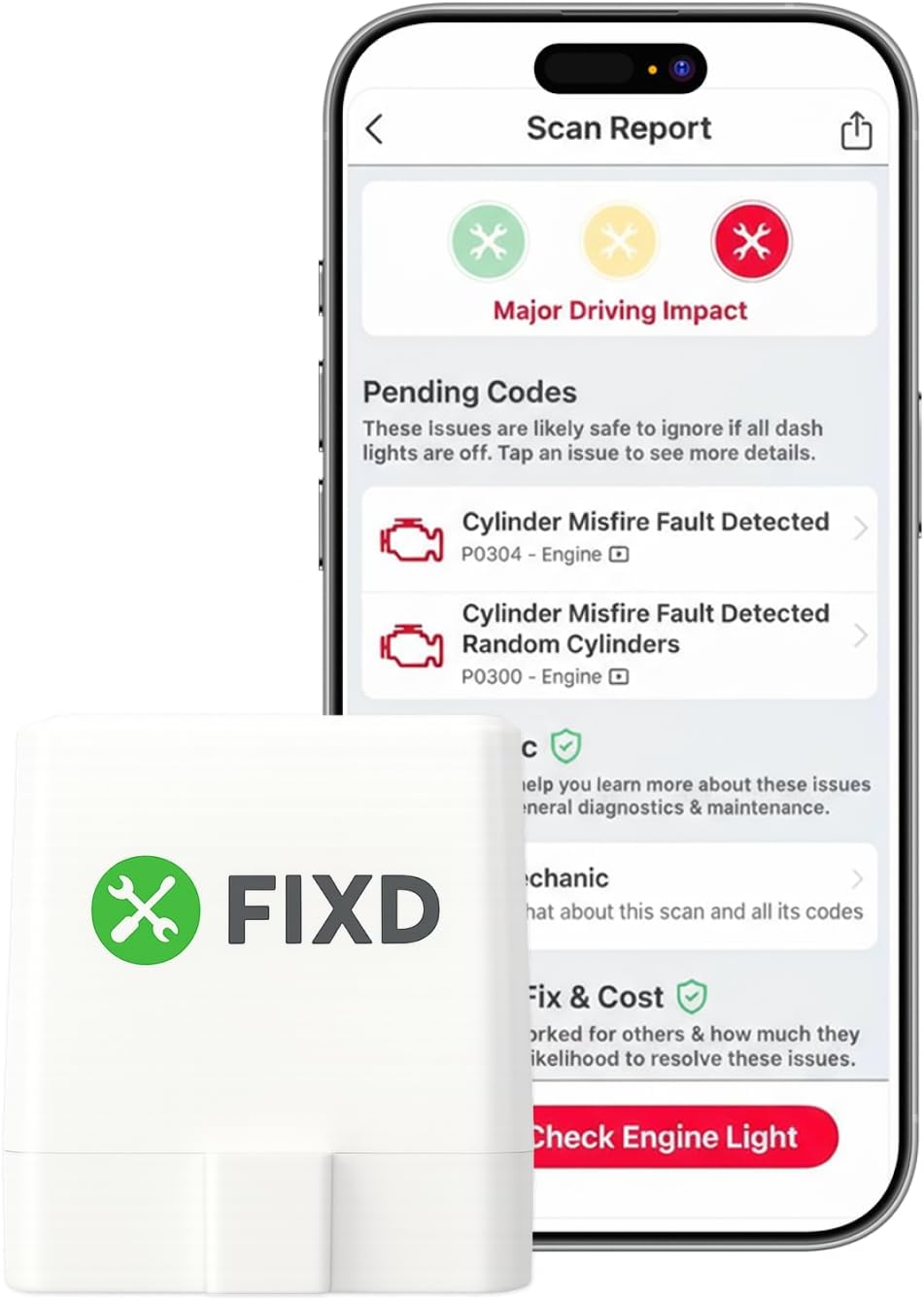
Best Bluetooth OBD2 Scanner
Detect 39,000+ Issues With Enhanced Codes. Save $1000s on car repairs & buying used vehicles by diagnosing problems yourself.
Shop on Amazon
Key Takeaways
- A steady Honda Civic check engine light allows cautious driving to a repair shop, but a flashing light demands immediate stopping to prevent up to $1,200+ in catalytic converter damage from unburned fuel overheating the converter substrate.
- Reading the OBD-II code is essential because a single trouble code like P0420 can point to multiple potential causes—a failing converter, drifting O2 sensors, exhaust leaks, or worn spark plugs—making blind parts replacement wasteful and counterproductive.
- The most common Civic check engine light triggers are loose gas caps (EVAP codes P0455/P1457), oxygen sensor degradation after 80,000–120,000 miles, worn spark plugs every 60,000–105,000 miles, and air-fuel mixture faults requiring MAF cleaning or sensor replacement.
- Stack related codes together to identify the root cause: for example, P0171 plus P0174 plus P0101 signals a dirty mass airflow sensor solvable with a $12 MAF cleaner instead of expensive converter replacement.
- After repairing the underlying fault and clearing codes, drive 50–100 miles through varied conditions to complete the readiness monitor cycle and confirm the repair was successful before an emissions test.
- Preventative maintenance including 5,000–7,500 mile oil changes, 15,000–30,000 mile air filter replacements, top-tier gasoline, and routine fluid checks will keep your Honda Civic running reliably while reducing repeat check engine light alerts.
Steady Versus Flashing Light
When It Is Usually Safe to Drive Cautiously
A solid, non-blinking check engine light means the ECU logged a fault but hasn’t detected an active critical failure. You can typically drive to a parts store or shop within a few miles, but reduce heavy acceleration and highway speeds. Common culprits, like a slightly loose gas cap after refueling or a lazy downstream oxygen sensor, won’t leave you stranded immediately. Still, don’t ignore it for weeks: unresolved codes can cascade into bigger issues.
If the Econ light also illuminates on 2016+ Civics, the system restricted VTEC engagement or disabled hybrid-assist functions to protect the powertrain. Performance feels sluggish, but the car remains drivable. Check your oil level first: low oil triggers VTEC pressure codes P1259 or P2646, especially on 1.5T and 2.0L engines.
Why a Flashing Light Requires You to Stop
A blinking check engine light signals an active, severe misfire, unburned fuel is entering the exhaust and heating the catalytic converter to destructive temperatures. Pull over safely, turn off the engine, and arrange a tow. Driving even a few blocks can melt the converter’s ceramic substrate, turning a $50 spark-plug fix into a $1,200+ repair.
“Drove my 2020 Civic Si with a flashing CEL for 10 minutes, converter destroyed. Don’t be me.” via r/Honda
Misfire codes P0300 (random), P0301 (cylinder 1), P0302 (cylinder 2), P0303, or P0304 point to fouled plugs, failed ignition coils, or injector clogs. On 1.5L Turbo models, oil dilution from short trips fouls plugs faster, a well-documented concern.
Symptoms That Call for Towing or Immediate Service
Beyond a flashing light, watch for these red flags:
- Rough idle, stumbling, or stalling: Indicates fuel delivery or ignition failure.
- Smoke from exhaust: White (coolant), blue (oil), or black (rich fuel) suggests internal damage.
- Loss of power, limp mode, or no acceleration: ECU limits RPM to prevent further harm.
- Overheating or coolant-temperature warning: Stop immediately: head-gasket or radiator failure.
- Burning smell or fluid leaks: Potential fire hazard or major fluid loss.
If any of these appear alongside the CEL, don’t drive. Call a tow truck and plan a full diagnostic at a shop with Honda-specific scan tools.
Read the Code
How On-Board Diagnostics Works
Your Civic’s ECU monitors dozens of sensors, oxygen, mass airflow, throttle position, coolant temperature, knock, cam/crank position, and compares real-time data against programmed thresholds. When a reading falls outside normal range for two consecutive drive cycles, the ECU stores a Diagnostic Trouble Code (DTC) and illuminates the check engine light. The system doesn’t guess: it flags the circuit or sensor that misbehaved.
Codes follow a five-character format: P (powertrain), U (network), B (body), or C (chassis), then four digits. Generic OBD-II codes (P0xxx) apply to all makes: manufacturer-specific codes (P1xxx) are Honda proprietary. P0455 is a large EVAP leak: P1457 is Honda’s code for a loose or missing gas cap.
Using an OBD-II Scanner on a Civic
Locate the 16-pin OBD-II port under the driver-side dash, left of the steering column. Plug in a Bluetooth OBD-II scanner (BlueDriver, FIXD, or Autel models work well), turn the ignition to ON (engine off), and pair with the scanner app on your phone.

Pull both active and pending codes. Active codes triggered the light: pending codes are one-trip faults that haven’t repeated. Note freeze-frame data, engine speed, coolant temp, and load at the moment the fault occurred. This snapshot helps pinpoint intermittent issues. Don’t just clear codes and hope: the light will return if the fault persists.
Why Trouble Codes Need Proper Diagnosis
A code tells you where the ECU detected a problem, not what caused it. P0420 (catalyst efficiency below threshold) might mean a failing converter, but it also appears when upstream or downstream O2 sensors drift, exhaust leaks confuse sensor readings, or old spark plugs cause incomplete combustion. Replacing the converter first wastes $1,000+ if the real culprit is a $30 sensor or $60 plug set.
Stack codes together. P0171 (system too lean, bank 1) plus P0174 (too lean, bank 2) plus P0101 (MAF range/performance) points to a dirty mass airflow sensor, a can of MAF cleaner often solves it. Single-code tunnel vision leads to parts-swapping frustration.

How to Clear the Light After a Verified Repair
After fixing the root cause, tightening the gas cap, replacing the O2 sensor, cleaning the MAF, clear codes with your scanner or disconnect the battery negative terminal for 15 minutes. The ECU resets and enters a “readiness monitor” phase, re-checking each system over several drive cycles.
If the repair was successful, the light stays off and monitors set to “Ready.” If the fault returns within 50 miles, you missed something or the diagnosis was incomplete. Don’t clear codes right before an emissions test: inspectors fail cars with incomplete monitors. Drive 50–100 miles through varied conditions, city, highway, cold start, hot soak, to complete the readiness cycle.
Most Common Causes
EVAP Leaks, Gas Caps, and Fuel Vapor Codes
P0455 and P1457 are the most frequent Civic codes. After refueling, if you didn’t hear three clicks tightening the cap, the ECU detects a large EVAP leak. Remove and reinstall the cap firmly: drive 20–30 miles through a mix of speeds. The light often clears on its own after two drive cycles. If it doesn’t, inspect the cap’s rubber seal for cracks, replacement caps cost $15–25 at Honda or auto-parts stores.
Persistent EVAP codes point to a faulty purge valve, charcoal-canister crack, or split vapor hose. The purge valve (often near the intake manifold on Civics) clicks when commanded open: a stuck-open valve floods the intake with fuel vapor, causing rough idle and P0441. Replacing the valve runs $40–80 and takes 20 minutes.
Oxygen Sensors and Air-Fuel Mixture Faults
Civics mount two to four O2 sensors: upstream (pre-cat) sensors measure exhaust and adjust fuel trim in real time: downstream (post-cat) sensors verify converter efficiency. P0131, P0132, P0135 (bank 1 sensor 1) and P0141 (bank 1 sensor 2) indicate heater-circuit or voltage faults. Sensors degrade after 80,000–120,000 miles, responding sluggishly or freezing at one voltage.
Symptoms include poor fuel economy, hesitation, and rough idle. Upstream sensor failure triggers P0171/P0174 lean codes or P0172/P0175 rich codes as the ECU compensates. Replacement sensors cost $50–150: use OEM Denso or NGK units for best longevity. Avoid ultra-cheap sensors, they fail within months and trigger new codes.
Misfires From Spark Plugs, Coils, and Injectors
P0300–P0304 misfire codes often trace to worn spark plugs. Honda specifies iridium plugs every 60,000–105,000 miles depending on the model. On 1.5L Turbo engines prone to oil dilution, plugs foul sooner, inspect them every 30,000 miles if you make frequent short trips. Black, wet, or oil-coated electrodes confirm the issue. A complete plug set runs $30–60 and takes 30–45 minutes to install.
If plugs look clean, swap ignition coils between cylinders. If the misfire code moves (P0301 becomes P0302 after swapping coil 1 to cylinder 2), the coil is bad. Coils cost $40–80 each: replace all four on high-mileage engines to prevent repeat failures. Fuel-injector clogs cause misfires too, add a bottle of Techron or SeaFoam to a full tank and run a highway drive to clean them.
Catalyst, Exhaust, and EGR System Problems
P0420 (catalyst efficiency below threshold, bank 1) and P0430 (bank 2) appear when the converter no longer reduces emissions effectively. Before replacing the converter, verify upstream and downstream O2 sensor voltages with live data. If both sensors mirror each other (both switching 0.1–0.9 V), the catalyst substrate is dead. If only one sensor is lazy, replace that sensor first.
Exhaust leaks near O2 sensors, cracked manifold gaskets or rusted flex pipes, confuse sensor readings and trigger false P0420 codes. Listen for ticking or hissing at startup. P0401 (EGR insufficient flow) and P0404 (EGR valve range/performance) plague older Civics: carbon buildup clogs the EGR valve and passages. Remove, clean with carburetor cleaner, and reinstall, or replace the valve ($120–200).
Air, Fuel, Temperature, and Transmission Inputs
P0101, P0102, P0103 (MAF sensor issues) cause stalling, rough idle, and poor acceleration. Clean the MAF’s hot-wire element with dedicated MAF cleaner, never touch the wire or use throttle-body cleaner. If cleaning doesn’t help, replace the sensor ($80–150).
P0335 (crank position sensor) and P0340 (cam position sensor) prevent starting or cause stalling: these sensors rarely fail but corroded connectors do. P0128 (coolant thermostat) means the engine runs too cool, common in northern climates: replace the thermostat ($30–60). Transmission-range codes (P0705, P0720) on CVT Civics often need dealer-level diagnostics: fluid condition and software updates matter.
Repair Decisions and Prevention
Avoiding Expensive Converter Damage
Catalytic converters cost $600–1,500 installed, yet many failures stem from ignored upstream faults. Fix misfires, O2 sensors, and EVAP leaks promptly, unburned fuel and oil contamination destroy converter substrates. A flashing CEL means stop now: continued driving guarantees converter death. Annual exhaust inspections catch leaks and sensor drift before they escalate.
When DIY Checks Make Sense
You can handle gas-cap tightening, MAF cleaning, spark-plug replacement, and code reading at home with basic tools and a socket set. Watch a Honda Civic spark plug replacement tutorial to see the procedure, it’s straightforward on most engines. Oil-level checks take 60 seconds and prevent VTEC codes.
“Checked my gas cap after P0455. Tightened it, reset the code, light gone. Saved $150 shop diagnostic fee.” via CivicX Forum
But resist the urge to replace parts blindly. If you can’t interpret freeze-frame data or don’t own a multimeter to test sensor voltages, take the car to a trusted shop.
When to Book a Professional Diagnostic
Complex issues, cam/crank correlation codes, CVT faults, hybrid-system alerts, network codes (U-codes), or stacked codes with conflicting symptoms, need dealer or independent Honda-specialist scans. Honda’s HDS (Honda Diagnostic System) offers deeper access than generic OBD-II scanners, revealing module-level data, performing actuator tests, and flashing ECU updates. Expect $100–150 for a thorough diagnostic: many shops waive the fee if you approve the repair.
Maintenance Habits That Reduce Repeat Alerts
Routine steps that keep your Civic’s CEL off:
- Change engine oil every 5,000–7,500 miles (0W-20 synthetic): low/dirty oil triggers VTEC and VTC codes.
- Replace air filter every 15,000–30,000 miles: clogged filters strain the MAF.
- Use top-tier gasoline: detergent additives prevent injector clogs.
- Inspect and replace PCV valve every 60,000 miles: a stuck valve causes oil consumption and rough idle.
- Check coolant, brake fluid, and transmission fluid per the owner’s manual.
- Address minor leaks and worn mounts early: vibration damages sensors and connectors.
Consistent maintenance, immediate code diagnosis, and proactive repairs transform the check engine light from a panic button into a helpful advisor, keeping your Honda Civic reliable for 200,000+ miles.
Frequently Asked Questions
What does a Honda Civic check engine light mean?
A Honda Civic check engine light indicates your On-Board Diagnostics (OBD-II) system detected a fault—ranging from a loose gas cap (EVAP code P0455) to serious misfires. A steady light allows cautious driving to a repair shop; a blinking light signals severe misfire and requires immediate stopping to prevent catalytic converter damage.
Is it safe to drive with a solid check engine light on?
Yes, a steady check engine light typically allows cautious driving to a repair shop within a few miles. Reduce heavy acceleration and highway speeds. Common culprits like loose gas caps or lazy O2 sensors won’t leave you stranded immediately, but don’t ignore it for weeks as unresolved codes can cascade into bigger problems.
How do I read a Honda Civic check engine code?
Locate the 16-pin OBD-II port under the driver-side dash left of the steering column. Plug in a Bluetooth OBD-II scanner (BlueDriver, FIXD, or Autel), turn the ignition ON (engine off), and pair with the scanner app. Pull both active and pending codes plus freeze-frame data to pinpoint the fault accurately.
What are the most common check engine codes on Honda Civics?
P0455 (large EVAP leak/loose gas cap), P0131–P0135 (oxygen sensor faults), P0300–P0304 (misfires from fouled plugs or coils), and P0420 (catalyst efficiency below threshold) are most frequent. Stack codes together—P0171 plus P0174 plus P0101 typically points to a dirty mass airflow sensor, often fixable with a $12 MAF cleaner.
Why is a blinking check engine light dangerous on a Honda Civic?
A blinking light signals active, severe misfire where unburned fuel enters the exhaust and heats the catalytic converter to destructive temperatures. Driving even a few blocks can melt the converter’s ceramic substrate, turning a $50 spark-plug fix into a $1,200+ repair. Pull over immediately and arrange a tow.
How can I prevent check engine lights on my Honda Civic?
Change oil every 5,000–7,500 miles (0W-20 synthetic), replace air filters every 15,000–30,000 miles, use top-tier gasoline, inspect the PCV valve every 60,000 miles, and address minor leaks early. Routine maintenance and immediate diagnosis transform the check engine light from a panic button into a helpful advisor for long-term reliability.
Read More:
- Honda Check Engine Light (Means, Causes and How to Decode)
- Honda CR-V Check Engine Light (What It Means and How to Fix It Fast)
- How to Fix EPC Light on Audi (The Complete Diagnostic and Fix Guide)
- How to Fix EPC Light on VW (Common Causes and Solutions)
- Chevy Check Engine Light (Means, Root Causes & How to Fix It)