
You’re cruising down the highway in your Compass when that amber symbol pops up on the dash, instant stress. Is it serious? Can you keep driving?
The Jeep Compass check engine light typically triggers due to a loose gas cap, EVAP system leak (P0440/P0456), MultiAir actuator fault (often from low oil), oxygen sensor failure, or ignition misfire (P0300-P0304). A solid light often indicates a minor sensor or emissions issue you can drive with temporarily, while a flashing light signals an active engine misfire that can destroy your catalytic converter if you don’t pull over immediately.
This guide walks you through the most common causes, real-world diagnostic trouble codes (DTCs), and practical DIY fixes, so you can decide whether to grab your OBD2 scanner or head straight to the shop. Let’s decode that warning.
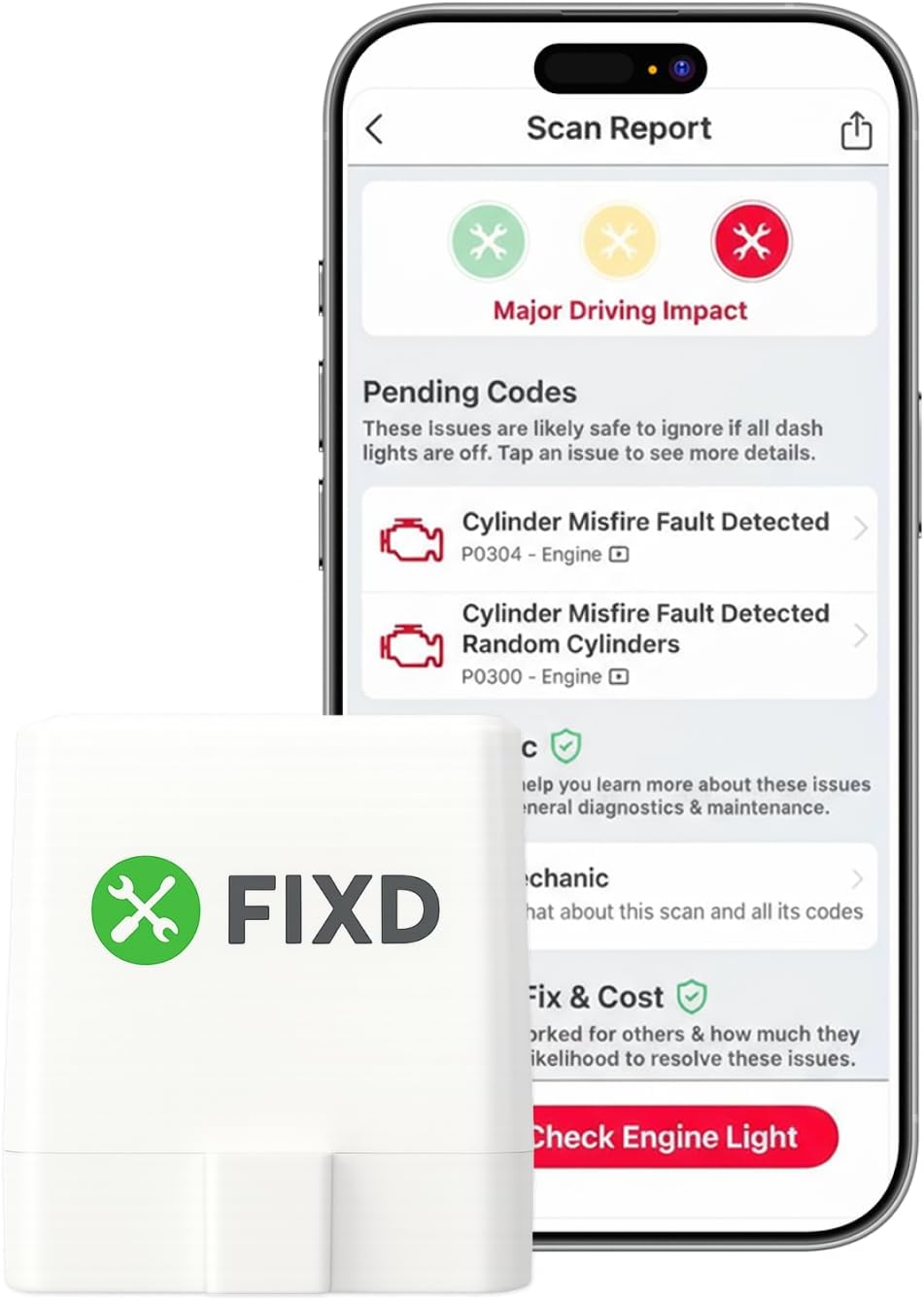
Best Bluetooth OBD2 Scanner
Detect 39,000+ Issues With Enhanced Codes. Save $1000s on car repairs & buying used vehicles by diagnosing problems yourself.
Shop on Amazon
Key Takeaways
- A solid Jeep Compass check engine light typically indicates a minor sensor or emissions issue you can address soon, while a flashing light signals active misfiring that can damage your catalytic converter within minutes and requires immediate attention.
- The most common causes of a Jeep Compass check engine light are a loose gas cap, EVAP system leaks, MultiAir actuator faults from low oil, oxygen sensor failure, and ignition misfires—many of which you can diagnose with a $30–$100 OBD-II scanner.
- Always check your oil level first on 2.4L Tigershark engines, as even half a quart low can cause P1128 MultiAir codes; use only 0W-20 full synthetic oil to prevent electro-hydraulic actuator failures.
- Before replacing an expensive catalytic converter for a P0420 code, swap the downstream oxygen sensor first, as a lazy sensor often triggers the same warning without requiring the $1,200+ repair.
- Free code-reading services at AutoZone, O’Reilly, and Advance Auto provide a zero-cost first diagnostic step; write down all codes and cross-reference them with Jeep forums to identify platform-specific quirks.
- Never clear the check engine light without fixing the underlying issue—masking the fault can allow minor problems to cascade into catastrophic engine or emissions damage costing thousands in repairs.
What the Check Engine Light Means
Solid vs Flashing Indicators
A solid amber check engine light, often called the Malfunction Indicator Lamp (MIL), means the Compass’s powertrain control module (PCM) has detected an emissions- or engine-related fault, but it’s not immediately catastrophic. You can usually drive a short distance to a safe spot or auto parts store.
A flashing light, but, screams urgency: the engine is misfiring badly enough to dump unburned fuel into the exhaust, which can overheat and permanently damage the catalytic converter within minutes. If you see flashing, reduce speed, avoid hard acceleration, and pull over as soon as it’s safe. Don’t ignore it.
Onboard Diagnostics and Malfunction Indicator Lamp
Your Jeep Compass uses OBD-II (On-Board Diagnostics, second generation) to continuously monitor dozens of sensors, oxygen sensors, mass airflow (MAF), throttle position, crankshaft position, and more. When a reading falls outside the PCM’s expected range for two consecutive drive cycles, it logs a diagnostic trouble code (DTC) and illuminates the MIL.
Jeep’s system is particularly sensitive to EVAP (evaporative emissions) faults and MultiAir valve issues on 2.4L Tigershark engines, which rely on electro-hydraulic actuators that fail when oil level or viscosity drops.
Potential Impact on Fuel Economy and Emissions
A lit check engine light almost always means something is running rich, lean, or inefficiently. Expect worse MPG, sometimes 10–20% below normal, and higher tailpipe emissions. If your state requires periodic emissions testing, the MIL triggers an automatic fail, even if the underlying fault is minor.
Unresolved misfires or stuck-open purge valves can also foul spark plugs, accelerate carbon buildup, and degrade the catalytic converter, turning a $30 sensor fix into a $1,500 parts-and-labor bill.
Leading Causes and Related Error Codes
Loose Gas Cap and Evaporative System Issues
The #1 trigger, especially for P0456 (small EVAP leak) or P0457 (loose cap), is a gas cap that wasn’t clicked three times after refueling. A cracked seal, cross-threaded cap, or aftermarket cap that doesn’t meet OEM specs can let fuel vapor escape, confusing the EVAP pressure sensor.
On 2017–2026 Compass models, the ESIM (Evaporative System Integrity Module) valve, a diaphragm pump near the fuel tank, frequently fails around 60,000–80,000 miles, triggering P0440 or P0442. According to Car Complaints, this is one of the most reported issues across MK and MP generations.
Sensor Failures (MAF, Oxygen, Mass Airflow)
Oxygen sensors (upstream or downstream) typically fail between 70,000–100,000 miles, logging codes like P0134, P0420 (catalyst efficiency below threshold), or P0138. A failing upstream O₂ sensor causes rough idle, hesitation, and poor fuel trim. MAF sensors get contaminated by oil mist or dirt, yielding P0171 (system too lean) or P0101 (MAF performance). Always use the correct oil viscosity (0W-20 for MultiAir engines) to minimize vapor contamination.
Spark Plug and Ignition Problems
Ignition coil packs on the 2.4L Tigershark are known weak points. A single failing coil or fouled spark plug triggers P0300 (random misfire), P0301–P0304 (cylinder-specific misfire), and often a flashing MIL. Jeep recommends plug replacement at 30,000 miles under severe-duty schedules, but many owners stretch it to 60,000, by which point carbon tracking and electrode erosion cause serious driveability issues.
“My 2018 Compass started shaking at idle. Scanned P0302 and swapped the coil pack, light went off. Total cost: $40 for the part.” via r/JeepCompass
Catalytic Converter and Emission Control
P0420 (catalyst efficiency below threshold, Bank 1) is one of the most dreaded codes. Sometimes it’s a genuine cat failure, often from prolonged misfires or cheap aftermarket parts, but it can also be a downstream O₂ sensor reading lazy. Before replacing a $1,200 catalytic converter, swap the downstream sensor and clear the code. If it returns after 50 miles, the cat is likely toast.
Common Error Codes (P0300, P0420, Others)
| Code | Description | Typical Cause |
|---|---|---|
| P0300 | Random misfire detected | Ignition coil, spark plugs, fuel injector |
| P0420 | Catalyst efficiency low (Bank 1) | Catalytic converter, O₂ sensor |
| P0456 | EVAP small leak detected | Loose/cracked gas cap, ESIM valve |
| P0128 | Coolant thermostat rationality | Stuck-open thermostat |
| P1128 | MultiAir system performance | Low oil, failed MultiAir solenoid |
P0128 is extremely common in cold climates, the thermostat sticks open, engine never reaches operating temp, and the PCM sets a fault. P1128 is MultiAir-specific: if your oil level is even half a quart low, the electro-hydraulic actuator can’t modulate valve lift, and the light comes on. Always check oil first on a 2.4L Tigershark.
Diagnosing and Resolving the Warning
Using an OBD-II Scanner and Reading Codes
Grab a BlueDriver Bluetooth OBD2 scanner ($100) or a budget ANCEL AD310 ($30). Plug it into the OBD port (under the steering column, driver’s side), turn the ignition to ON (engine off), and launch the app. Write down every code, pending or confirmed. Google each one or cross-reference with Jeep forums to see if it’s a known platform quirk.

DIY Solutions vs Mechanic Involvement
- You can handle: Gas cap replacement, topping off oil, clearing codes after a fix, swapping spark plugs or ignition coils (15-minute job per cylinder), replacing the air filter.
- You should defer: ESIM valve replacement (requires raising the vehicle and disconnecting fuel lines), catalytic converter swap, MultiAir actuator overhaul, anything involving the PCM or wiring harness.
Steps to Reset the Light Safely
- Fix the root cause (tighten cap, replace sensor, etc.).
- Drive the vehicle through at least one full drive cycle: cold start → idle for 3 min → highway speeds for 10 min → city driving → shut down.
- Reconnect your scanner and select Clear Codes / Reset MIL.
- If the light returns within 50 miles, the fault is still active or a related component has failed.
Never just clear codes and ignore them, you’ll mask a problem that can cascade into expensive damage.
Locating Help at Auto Parts Stores
Most AutoZone, O’Reilly Auto Parts, and Advance Auto locations offer free code scanning and will print a report. Staff can also look up TSBs (Technical Service Bulletins) and common fixes. It’s a zero-cost first step before you commit to a mechanic.
Prevention, Maintenance, and Long-Term Reliability
Scheduled Maintenance and Routine Inspections
Stick to Jeep’s service intervals in your owner’s manual. Change oil every 5,000–6,000 miles (or sooner if you see the MultiAir system warning). Inspect the air filter every 15,000 miles, and replace spark plugs and ignition coils by 60,000 miles on the 2.4L. Check your auxiliary 12V stop-start battery (located in the rear cargo area on many Compass models) annually: weak voltage can trigger phantom electrical codes.
“I had three random codes clear after replacing the aux battery. My scanner showed 11.8V instead of 12.6V, that was enough to confuse the PCM.” via Jeep Renegade Forum
Avoiding Sensor and Emissions Issues
- Use top-tier gasoline (Shell, Chevron, Mobil) to reduce carbon deposits.
- Avoid aftermarket intake or exhaust mods that throw MAF or O₂ sensor readings off.
- Replace the cabin air filter and engine air filter on schedule, dirty filters starve the engine and skew MAF data.
- Keep the gas tank above ¼ full to prevent EVAP system pressure faults.
Tips for Passing Emissions Tests
If your state requires OBD readiness monitors (California, New York, etc.), you need all readiness flags set to “Ready” except EVAP (which can be “Not Ready” in some states). After clearing codes, drive 50–100 miles through varied conditions, city, highway, idle, to allow the PCM to run self-tests. According to the EPA, a check engine light automatically fails inspection, so resolve and clear codes before your appointment.
Expert Note: "The 2.4L Tigershark MultiAir's electro-hydraulic valve actuation is extremely oil-dependent. Even half a quart low oil causes insufficient hydraulic pressure, leading to intermittent P1128 codes and rough idle. Always verify oil level and spec (0W-20 full synthetic) before chasing sensor faults."
For a complete diagnostic toolkit, grab the LAUNCH CRP123X OBD2 scanner, it reads ABS, airbag, and transmission codes plus to engine DTCs, making it a solid long-term investment for any Compass owner.

Frequently Asked Questions
What does a solid vs. flashing check engine light mean on a Jeep Compass?
A solid amber check engine light indicates a minor emissions or sensor issue; you can drive short distances to a mechanic. A flashing light signals active engine misfire, dumping fuel into the exhaust and risking catalytic converter damage within minutes. Pull over immediately if flashing.
What are the most common causes of check engine light in a Jeep Compass?
Top triggers include a loose gas cap, EVAP system leaks (P0456/P0440), oxygen sensor failure, ignition coil or spark plug issues, and MultiAir actuator faults from low oil. The 2.4L Tigershark engine is particularly sensitive to EVAP and valve actuation problems.
Can I drive a Jeep Compass with the check engine light on?
With a solid light, you can drive short distances safely to a parts store or mechanic. However, expect 10–20% worse fuel economy and emissions. A flashing light requires immediate pullover to avoid permanent catalytic converter damage. Unresolved issues may fail emissions inspections.
How do I reset a Jeep Compass check engine light?
Use an OBD-II scanner to identify the fault code, fix the root cause, then drive through a complete cycle (cold start, highway, city). Reconnect the scanner and clear codes. If the light returns within 50 miles, the underlying problem persists and requires professional diagnosis.
What is code P0420 and why is it expensive?
P0420 indicates catalyst efficiency is low, often requiring catalytic converter replacement ($1,200+). However, before replacing, test your downstream oxygen sensor—a lazy sensor can trigger the same code. Swap the O₂ sensor and retest; catalytic converter failure stems from prolonged misfires.
Why does low oil cause check engine light codes on Jeep Compass MultiAir engines?
The 2.4L Tigershark’s electro-hydraulic MultiAir valve actuators require precise oil pressure to modulate valve lift. Even half a quart low causes insufficient hydraulic pressure, triggering P1128 codes and rough idle. Always use 0W-20 full synthetic and maintain proper levels.
Read More:
- Jeep Check Engine Light (Here’s the Quick Diagnostic Guide)
- Jeep Cherokee Check Engine Light (Means and How to Fix It Fast)
- Jeep Grand Cherokee Check Engine Light (Means and Triggers Explained)
- Ford Check Engine Light (Means and Step-By-Step Diagnosis)
- BMW Check Engine Light (Quick Diagnostic Guide to Fix It Fast)